
Reviewed November 2026 · Northeast Florida
The short answer: once a month for most Northeast Florida households, and every two weeks if pets, diapers, seafood scraps, or a bin in full sun are part of your week. A trash bin is a warm, dark, wet container that holds food residue for seven days at a time. Florida heat turns that residue into odor, flies, and a sticky film on the plastic within days, which is why a hose rinse never seems to hold.
Why Florida heat changes the math
In a mild climate, a bin can go a couple of months before the smell becomes obvious. Around Jacksonville and St. Johns County, summer temperatures hold in the nineties with high humidity, and a bin sitting against a garage wall or beside a fence effectively becomes an incubator. Food residue that would dry out elsewhere stays moist, and flies find it fast.
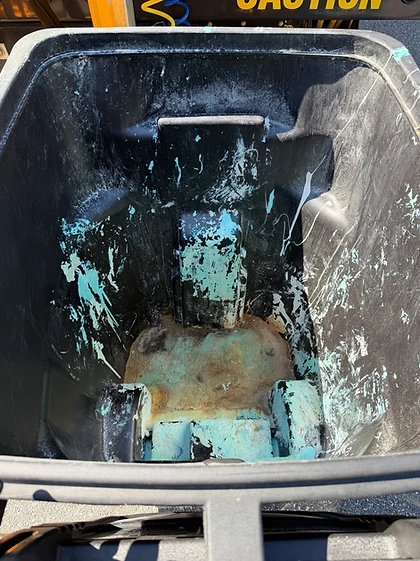
The practical consequence is that the residue hardens onto the plastic and the lid gasket. Once that layer forms, rinsing pushes water over the top of it rather than removing it, so the smell returns a day after pickup. That cycle is the main reason people describe their bins as permanently sour.
How often to clean, by household
Frequency should follow what actually goes in the bin, not a calendar guess. These are the intervals we schedule in the field:
What a real cleaning actually removes
A rinse and a real cleaning are not the same job. A garden hose delivers room-temperature water at low pressure for a few seconds. Professional curbside cleaning delivers heated, pressurized water with product and a sanitizing step, then removes the water instead of spreading it around your driveway.
- 1The empty bin is lifted and emptied of loose debris before washing starts.
- 2High-temperature pressurized water reaches the lid, handles, walls, floor, and the corners a garden hose misses.
- 3Surfaces are treated with eco-conscious cleaning product and scrubbed where buildup sits.
- 4The bin is sanitized to knock down odor-causing bacteria, then deodorized so it stays fresh between pickups.
- 5Every drop of wastewater is captured in the truck and hauled off for responsible disposal.
Where the dirty water should go
This is the part most people never think about. Washing a bin in the driveway sends runoff carrying food residue and bacteria across the concrete and into the storm drain. Storm drains in Florida do not lead to a treatment plant; they lead to creeks, retention ponds, the Intracoastal, and the St. Johns River. Many municipalities prohibit discharging wash water that way, which is why responsible bin cleaning equipment captures the wastewater in a tank and hauls it off.
If your bin sits near a swale, a drain, or a waterfront lot, this matters even more. Capturing the water costs the crew a step and protects the water everybody in the neighborhood uses.
What it costs in Northeast Florida
Recurring residential bin cleaning in this market runs on a per-bin monthly plan, and the cost drops per bin once you add recycling or a second trash bin. One-time cleanings are available at a higher rate, mostly for move-outs, rentals, and bins that have gone a long stretch without attention. Our current plans start at $24.99 per bin per month, with no contracts, and the same price applies in every ZIP we serve.
When to call instead of DIY
DIY is reasonable for a light rinse on a cool week. It stops being reasonable once you can smell the bin from a few feet away, when there are flies around the lid, when the floor of the bin has a visible film, or when the runoff would cross a driveway, swale, or drain. Those are the cases where a heated, sanitized cleaning done above a capture tank solves in minutes what a hose only spreads around.